Chemical Resistance of ADC12 Aluminum Die Castings
Date: 2026-10-26 / Views: 60 / Category: What is Die Casting?
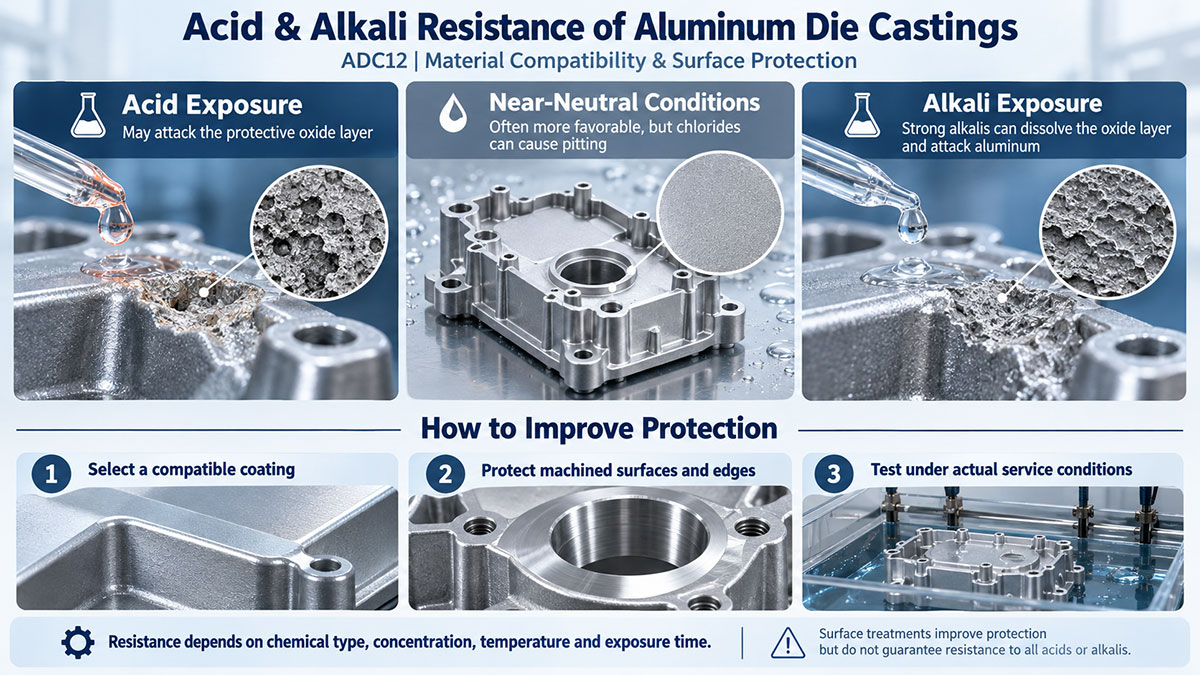
Aluminum die castings offer some resistance to chemicals, but they are not compatible with every chemical substance. For ADC12 aluminum die castings, particular care is required when exposed to acids, alkalis, cleaning agents, industrial solvents, and salt-containing liquids.
Aluminum naturally forms a thin protective oxide layer on its surface, which contributes to its corrosion resistance. If a chemical damages this layer, discoloration, corrosion, pitting, or leakage may occur.
1. General Chemical Compatibility of ADC12
|
Chemical Type |
General Compatibility |
Key Considerations |
|
General lubricating oils and gear oils |
Generally good |
Verify suitability for prolonged exposure under actual operating conditions. |
|
Mineral-based hydraulic oils |
Generally good |
Consider additives and water contamination. |
|
Alcohols, such as ethanol and IPA |
Often compatible under suitable conditions |
Check concentration, water content, temperature, and blended ingredients. |
|
Certain organic solvents, such as acetone |
Often compatible under suitable conditions |
Verify compatibility with seals and coatings as well. |
|
Neutral cleaning agents |
Generally suitable |
Avoid residue buildup and prolonged immersion without testing. |
|
Acidic cleaning agents |
High risk |
May damage the protective oxide layer. |
|
Strong alkaline cleaning agents |
Generally unsuitable |
Can aggressively attack aluminum. |
|
Chloride-containing saltwater and salt spray |
High risk |
Can cause localized pitting corrosion. |
|
Water-based cutting fluids |
Formulation-dependent |
Check pH and corrosion inhibitors. |
These ratings provide preliminary guidance for material selection and must not be treated as a guarantee of chemical resistance. Actual performance depends on chemical concentration, temperature, exposure duration, and the surface condition of the ADC12 casting.
2. Why Does ADC12 Require Special Attention?
ADC12 contains approximately 9.6–12.0% silicon and 1.5–3.5% copper. These elements support casting performance and mechanical properties, but the different phases within the alloy can also contribute to localized electrochemical corrosion.
Although ADC12 is well suited to the mass production of precision components, it should not automatically be considered a highly corrosion-resistant alloy in aggressive environments.
Common signs of chemical attack include:
-
White corrosion deposits: White powder or spots appear on the surface.
-
Pitting corrosion: Chloride exposure can produce small, localized cavities.
-
Surface discoloration: Chemical cleaning or corrosion causes an uneven appearance.
-
Coating delamination: Poor pretreatment or chemical penetration can cause coatings to separate from the substrate.
-
Loss of sealing performance: Corrosion damage to sealing surfaces may lead to fluid leakage.
3. How Can Chemical Resistance Be Improved?
|
Treatment Method |
Main Benefits |
Typical Applications |
|
Chemical conversion coating |
Improves corrosion resistance and paint adhesion |
General mechanical components |
|
Chemical conversion coating followed by powder coating |
Provides additional protection against external exposure |
Outdoor equipment and machinery housings |
|
Chemically resistant epoxy coating |
Provides a barrier against selected corrosive liquids |
Components exposed to compatible chemicals |
|
Specialized chemical-resistant coating |
Offers protection tailored to specific chemicals and operating conditions |
Specialized industrial environments |
|
Vacuum impregnation |
Seals certain interconnected pores to reduce leakage |
Castings requiring fluid tightness |
A surface treatment does not automatically make ADC12 suitable for prolonged immersion in strong acids or strong alkalis. For these applications, alternative materials—such as chemically resistant engineering plastics, suitable stainless steel grades, or other alloys—should be evaluated against the specific chemical and operating conditions.
Vacuum impregnation addresses leakage through interconnected porosity; it does not replace a corrosion-resistant surface coating.
4. Recommended Tests Before Mass Production
-
Chemical immersion testing: Evaluate corrosion, changes in mass, and surface appearance using the actual chemical formulation.
-
Chemical exposure testing at operating temperature: Reproduce the intended service temperature.
-
Coating adhesion testing: Check for blistering, peeling, or loss of adhesion after exposure.
-
Leak and pressure testing: Confirm that the component maintains its sealing performance after chemical exposure.
-
Salt spray or cyclic corrosion testing: Assess protection for humid or salt-containing environments.
5. Identify the Actual Chemical Exposure
To select an appropriate material and surface treatment, first identify the chemicals the ADC12 component will encounter:
-
Industrial cleaners and degreasers
-
Acidic chemicals
-
Alkaline chemicals
-
Organic solvents, such as alcohols and acetone
-
Cutting fluids, coolants, and antifreeze
-
Mixtures of multiple chemicals
The final material, coating, and inspection requirements should be based on the actual chemical formulation, concentration, temperature, and exposure duration.