The Ultimate Solution for Polar Climates: Why Aluminum Die Casting is Essential for Outdoor Cameras
Date: 2026-08-26 / Views: 86 / Category: What is Die Casting?
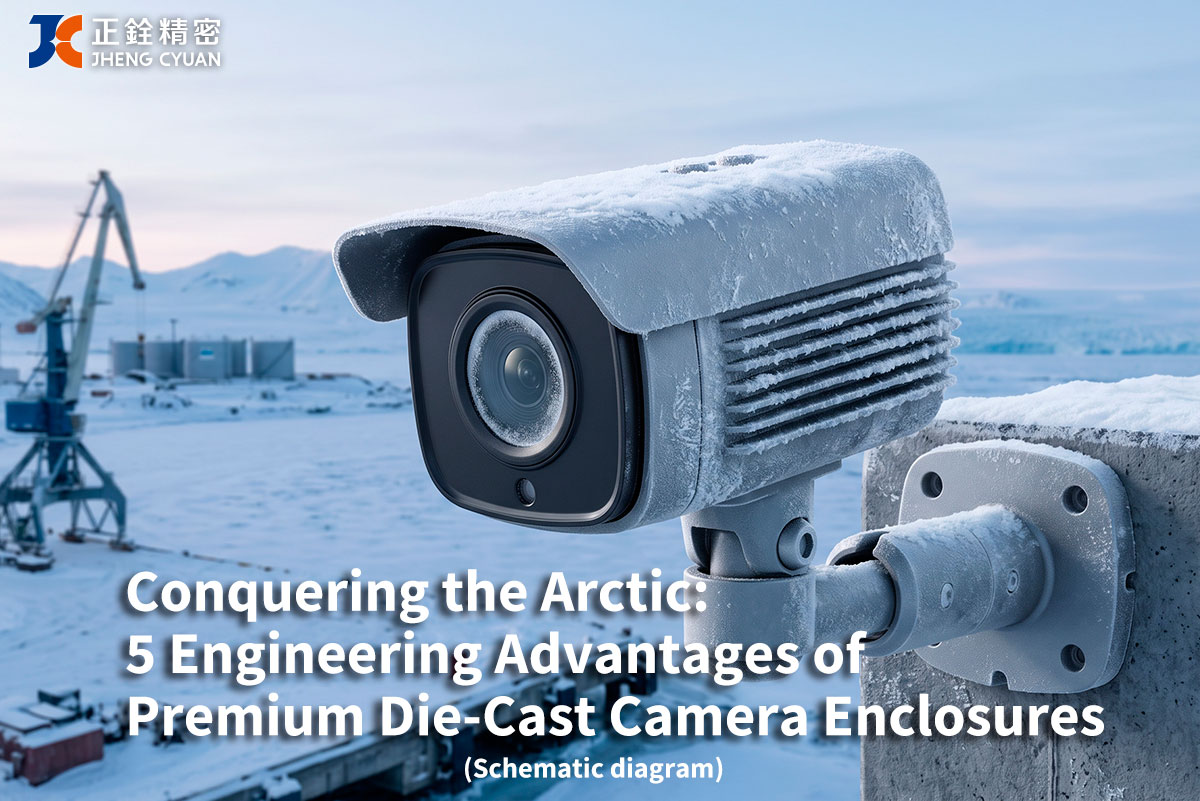
In extreme sub-zero environments ranging from -40°C to -60°C, traditional plastic enclosures are highly susceptible to low-temperature embrittlement, seal failure, and de-icing difficulties. Aluminum die-cast outdoor camera housings offer critical physical and mechanical advantages to overcome these harsh polar conditions:
1. Zero Low-Temperature Embrittlement (No DBTT)
-
Physical Property: Aluminum alloys possess a Face-Centered Cubic (FCC) crystal structure. Unlike carbon steel or plastics, aluminum does not exhibit a Ductile-to-Brittle Transition Temperature (DBTT).
-
Polar Performance: At -50°C and below, the tensile and yield strength of aluminum actually increases slightly while retaining excellent impact toughness. Under extreme weather impacts—such as heavy hail or blizzard debris—the enclosure will not shatter or crack like engineering plastics (e.g., PC or ABS), reliably maintaining an IK10 vandal resistance rating.
2. Uniform Thermal Conductivity: The "Self-De-icing" Carrier
-
Thermal Advantage: The thermal conductivity of aluminum alloys (approx. 96–150 W/m·K) is exponentially higher than that of plastics (~0.2 W/m·K).
-
Defrosting Mechanism: Polar cameras typically utilize built-in PTC heaters or scavenge waste heat from internal processors. The aluminum die-cast housing acts as a highly efficient heat sink in reverse, rapidly and evenly distributing heat across the entire surface and sunshield. This accelerates the melting of accumulated snow and hard ice, preventing heavy ice loads from collapsing mounting brackets or obstructing the camera lens.
3. CTE Matching & Cold-Shrink Sealing Stability
-
Eliminating Deformation Gaps: The Coefficient of Thermal Expansion (CTE) of aluminum (approx.
 ) closely matches that of the internal hardware, optical glass, and CNC-machined lens mounting rings.
-
Airtight Integrity: During drastic temperature drops, the die-cast aluminum and mating hardware contract synchronously. This uniform shrinkage prevents microscopic gaps from forming at the mating surfaces. When paired with extreme-cold-rated sealing rings (such as Fluorosilicone or low-temperature EPDM resistant to -60°C), the housing continuously sustains its IP67 / IP68 airtight integrity, completely blocking condensation intrusion.
4. Extreme "Thermal Shock" Coating Tolerance
-
Stress Resistance: Cameras in polar regions face severe thermal shock, such as an external environment of -40°C coupled with a sudden internal temperature surge to +40°C when heaters activate (a delta of over 80°C).
-
Coating Adhesion: Featuring a trivalent chromate conversion pre-treatment and outdoor-grade powder coating, the surface finish achieves a formidable 5B adhesion rating. Under violent thermal expansion and contraction, the paint layer resists micro-cracking and peeling, providing sustained defense against corrosive chemical de-icing salts and mud during the snowmelt season.
5. Structural Rigidity Against "Negative Pressure Suction"
-
Resisting Internal Vacuum: As the temperature plummets to -40°C, the trapped air inside the sealed cavity contracts violently, creating a powerful internal negative pressure (vacuum effect).
-
Maintaining Form: The superior structural rigidity of die-cast aluminum withstands this inward force without warping or caving in. Integrated with a polar-rated ePTFE breather vent, the housing effectively equalizes internal and external pressure, preventing freezing moisture from being forcefully sucked through the sealing joints.
Polar Environment Design Comparison
|
Challenge |
Common Plastic Housing Issues |
Aluminum Die-Casting Solution |
|
Low-Temp Impact |
Becomes brittle; shatters easily upon impact. |
FCC crystal structure gains strength; maintains IK10 rating. |
|
Ice Accumulation |
Poor thermal conductivity prevents internal heat from reaching the exterior. |
High thermal conductivity enables even heat distribution, rapidly melting ice. |
|
Seal Failure |
High thermal shrinkage causes deformation and air leaks. |
Uniform thermal contraction; sustains IP68 with cold-resistant O-rings. |
|
Weathering |
UV exposure and chronic cold lead to chalking and cracking. |
Chemically stable metal base with weather-grade powder coating ensures longevity. |
 Welcome to consult customized quotation