Mold Flow Analysis of Aluminum Die Casting Molds (MFA)
Date: 2026-07-28 / Views: 112 / Category: What is Die Casting?
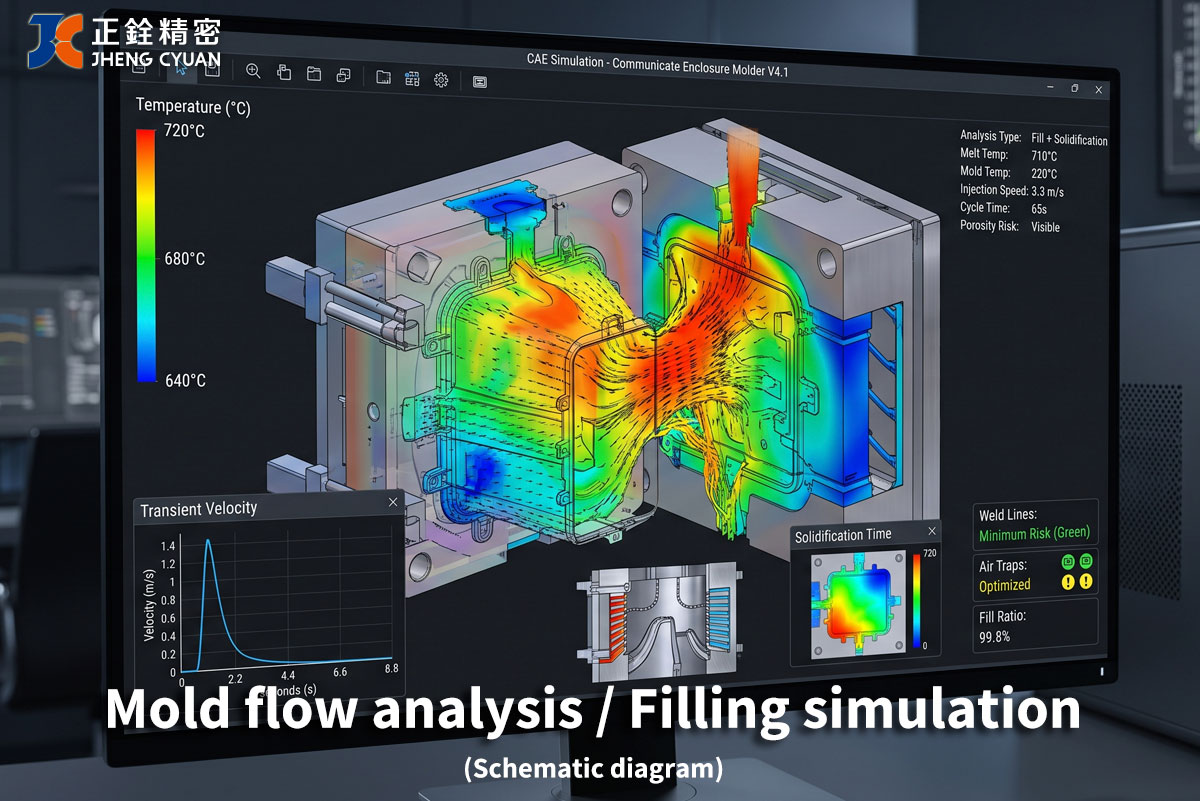
The Strategic Importance of Mold Flow Analysis in Aluminum Die Casting
Without mold flow analysis, developing an aluminum die-casting mold is like "opening a mystery box"—it carries high financial risk and trial-and-error costs.
In High-Pressure Die Casting (HPDC), where molten aluminum fills a mold cavity in a fraction of a second (often 0.01 to 0.05 seconds), Mold Flow Analysis (CAE Simulation) has evolved from an optional check to an indispensable industry standard.
Here are the four key reasons why mold flow analysis is critical for aluminum die casting:
1. Predicting Defects Early to Minimize Trial-and-Error Costs
Traditional mold development relies heavily on trial and error (T1, T2 trials) after the steel mold is built. Physical modifications to hardened tool steel are expensive and time-consuming.
Mold flow analysis identifies potential casting defects in the digital phase before tooling begins:
-
Air Traps and Porosity: Pinpoints where air becomes trapped within the molten metal stream.
-
Shrinkage Porosity: Predicts internal voids caused by insufficient material feeding during cooling.
-
Cold Shuts and Weld Lines: Identifies areas where converging metal streams drop in temperature, preventing full fusion.
-
Short Shots: Forecasts incomplete filling in thin sections or far-reaching regions.
2. Optimizing Runner, Gate, and Venting System Design
The geometry and placement of the runner, ingate, overflows, and air vents directly dictate casting quality.
Simulation allows engineers to:
-
Optimize Flow Dynamics: Balance fill rates and entry angles to minimize fluid turbulence and oxide formation.
-
Precision Venting Placement: Place overflows and vents at the absolute last points of fill to ensure maximum air evacuation.
3. Thermal Balance Control to Extend Tool Life and Reduce Cycle Time
Molten aluminum is injected at temperatures exceeding 650°C, subjecting molds to severe thermal stress.
-
Cooling Line Design: Simulates mold thermal distribution (hot spots) to optimize internal cooling channels.
-
Preventing Die Soldering and Cracking: Reduces localized overheating, mitigating thermal fatigue (heat checking) and significantly extending tool life.
-
Shortening Cycle Time: Enhances cooling efficiency to reduce the required solidification time before part ejection, boosting production output.
4. Enabling Lightweight Structural Design
In industries like automotive (EV chassis components) and telecommunications (5G enclosures), lightweighting is paramount.
Mold flow analysis verifies whether wall thicknesses can be reduced (e.g., from 3.0 mm down to 2.0 mm) without compromising fill capability or structural integrity. This leads to material savings, lower part weight, and optimized heat dissipation.
Summary
The core value of mold flow analysis lies in "making mistakes in the virtual environment so perfection is delivered in steel."
It can shorten product development cycles by 30% to 50%, while drastically reducing sampling costs and scrap rates. For complex, high-reliability components—such as IP68 waterproof enclosures, pressure-tight housings, or high-density heat sinks—mold flow analysis is an absolute essential for securing quality and delivery schedules.