How does an aluminum die casting machine operate?
Date: 2026-06-28 / Views: 147 / Category: What is Die Casting?

Operating an aluminum die casting machine is far more than simply "pouring metal" into a tool. It demands microsecond-level precision control over three critical elements: velocity, pressure, and time.
The following breaks down these three core operational phases—Cavity Injection, Holding & Intensification, and Die Opening—within a high-end Cold Chamber Die Casting Machine, demonstrating how they are elevated into a luxury-grade manufacturing process:
1. Injection Phase: The "Velocity Aesthetics" of Luxury Craftsmanship
Aluminum has a high melting point of approximately 660°C. Before entering the mold, the molten aluminum is ladled into the shot sleeve either manually or via a robotic arm. The machine’s plunger (piston) then injects the molten metal into the cavity through three distinct stages:
-
First Stage (Slow Approach): The plunger advances slowly to push the molten aluminum forward, effectively driving out and venting the air inside the shot sleeve. The velocity must remain low at this stage to prevent the metal from turbulent rolling, which traps air and forms gas porosities.
-
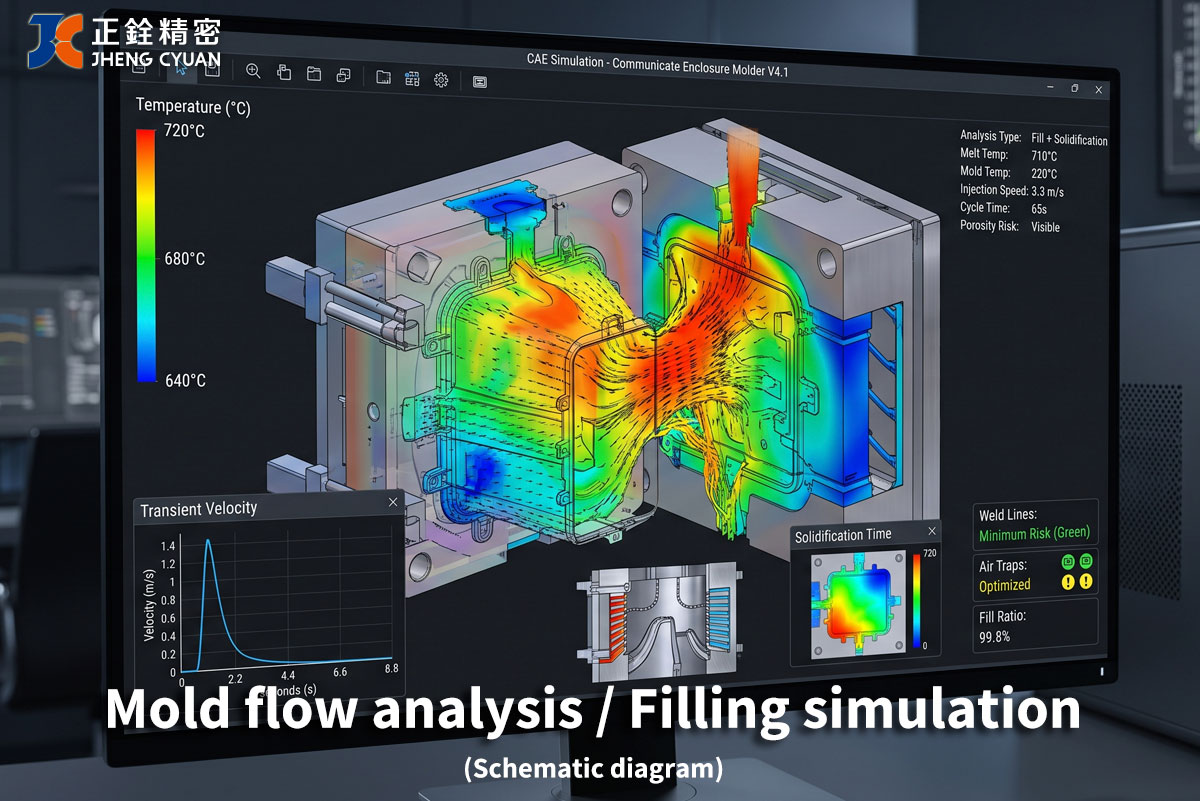
Second Stage (High-Speed Cavity Filling): As the molten aluminum reaches the gate, the plunger accelerates instantaneously, reaching velocities of 4 to 7 m/s. The molten aluminum atomizes like a fine mist, completely filling the complex security camera cavity within an ultra-short window of 0.03 to 0.1 seconds.
-
Luxury Craftsmanship Detail: If the injection velocity is insufficient, the molten aluminum will undergo localized temperature drops during advancement. This leads to cold shuts or flow marks on the housing surface, making it impossible to achieve the flawless, high-end matte finish required during subsequent sandblasting and painting processes.
2. Holding & Intensification Phase: The Key to Eliminating Porosity
The exact moment the molten aluminum fills the cavity and the plunger bottoms out, the machine's hydraulic system instantly triggers the intensification phase.
-
High-Pressure Forging: The machine applies immense pressure—typically ranging from 60 to 100 MPa (equivalent to nearly one ton of weight per square centimeter) — against the liquid aluminum. This critical action is known as holding pressure.
-
Forced Densification: Aluminum alloys shrink in volume during solidification and crystallization. The purpose of the holding pressure is to continuously "force-feed" the remaining liquid aluminum into the cavity at the exact moment of solidification to compensate for shrinkage. Simultaneously, any minute gas bubbles are compressed into microscopic, invisible gaps within the crystalline structure.
-
Luxury Craftsmanship Detail: This is the single most critical step in guaranteeing IP67/IP68 airtightness. If the holding pressure is inadequate or the intensification switchover is delayed, subsurface porosity will form inside the waterproof O-ring groove. These trapped air pockets will expand during high-temperature paint baking, resulting in surface blistering and a total failure of the batch.
3. Cooling & Ejection Phase: Perfect Geometric Forming
The molten aluminum undergoes rapid temperature reduction inside the mold (regulated by the highly precise 3D conformal cooling channels mentioned earlier). Once the solidified metal achieves sufficient structural strength, the machine's clamping mechanism retracts to execute Die Opening.
-
Die Opening and Core Pulling: Concurrent with the mold opening, lateral hydraulic cylinders activate to smoothly withdraw the sliders that form the camera's cable entries and mounting bracket holes.
-
Product Ejection: Once the die is fully opened, the machine's rear ejector system drives forward, allowing the ejector pins to smoothly and evenly push the fully formed camera housing out of the cavity.
-
Luxury Craftsmanship Detail: The precise timing of the die opening must be calculated via real-time computer algorithms. Opening the mold too early, while the aluminum is still soft, causes structural warping or ejector pin punch-through. Conversely, opening it too late causes the shrinking aluminum to grip the mold core too tightly, resulting in surface scoring (scratching) during forced ejection.
Complete Operational Process Sequence
1.1. Clamping & Ladling:Initial Setup。
The die components are locked securely under hundreds to thousands of tons of clamping force. A robotic arm pours a precisely metered dose of molten aluminum alloy (at approx. 680°C) into the cold chamber shot sleeve.
2.2. Three-Stage Injection:Completed within 0.1 seconds。
The plunger accelerates progressively from slow to ultra-high velocity, forcing the molten aluminum through the runner and gate system into the camera housing cavity.
3.3. Intensification & Holding:Airtight Defense Line。
The hydraulic injection system instantly switches to ultra-high pressure, maintaining continuous compression to eliminate internal voids and ensure maximum density along the waterproof mating surfaces.
4.4. Cooling & Die Opening:Dimensional Solidification。
Heat is rapidly extracted through the mold's engineered water lines. Once solidified, the clamping unit retracts, the sliders perform core pulling, and the perfectly formed part is revealed.
5.5. Ejection & Die Spraying:Cycle Reset。
The ejector pins push the finished component smoothly out of the tool. A robotic arm then sprays a die release agent (lubricant) onto the mold faces to cool and lubricate them, preparing for the next shot.
When communicating with international clients, Cheng Chuan Precision can confidently highlight that our die casting cells are equipped with a Real-Time Closed-Loop Control System. By digitizing and monitoring the injection velocity and holding pressure waveforms of every single shot, we deliver on the ultimate promise of consistency in Luxury Manufacturing.
 Welcome to consult customized quotation